
Equipment hire gives businesses access to useful machinery without the cost of owning a large fleet. It can support a one-day task, a long construction project, a remote mining job, or a seasonal increase in work.
Choosing hire equipment is not as simple as picking a machine and comparing daily prices. The equipment must suit the task, site, operator, and workload. Delivery, attachments, fuel, maintenance, and possible extra charges also matter.
This guide explains how equipment hire works in Perth and Western Australia. It covers hire options, equipment selection, costs, safety, transport, maintenance, and the responsibilities of the hirer.
What Is Equipment Hire?
Equipment hire allows a person or business to use machinery for an agreed period. The equipment remains the property of the rental company. The customer pays to use it under the hire terms.
The period may be one day, several weeks, or many months. Some agreements can also lead to the customer purchasing the equipment.
Equipment hire is used in construction, civil works, mining, utilities, landscaping, arboriculture, environmental work, industrial operations, and events.
The usual process is:
- Explain the work that needs to be completed.
- Select suitable equipment and attachments.
- Confirm the hire dates and location.
- Review the quote and terms.
- Arrange collection or delivery.
- Inspect and operate the equipment safely.
- Return the machine or arrange collection.
A clear project brief helps the rental company recommend a suitable machine.
Why Hire Equipment Instead of Buying It?
Buying can make sense when a machine is used almost every day. For many businesses, hiring offers more flexibility.
Lower Upfront Costs
Heavy machinery can require a large investment. Hiring allows a business to keep funds available for staff, materials, transport, and other project costs.
This can help contractors with changing workloads. It also avoids buying a machine for one short contract.
Access to Specialist Machines
Some jobs require equipment that is only used occasionally. Examples include vacuum excavators, trenchers, stump grinders, lighting towers, and waste balers.
Hiring gives a business access to the right machine when it is needed. There is no need to store it between projects.
A Better Match for Each Job
One machine will not suit every site. A compact tracked unit may suit a narrow area. A larger machine may be needed for greater output.
Hiring allows the equipment to be matched to the current project rather than forcing an owned machine to do unsuitable work.
Less Fleet Management
Ownership includes servicing, repairs, parts, storage, transport, records, and resale. These tasks take time and require staff.
A hire arrangement can reduce some of that pressure. The exact support depends on the agreement, so all inclusions should be checked.
ID Rent states that it provides scheduled maintenance and breakdown support for its hire fleet. It also records the service details of its equipment.
Short-Term, Long-Term, and Hire-to-Purchase Options
The right hire arrangement depends on the project length, expected machine use, and future business needs.
Short-Term Hire
Short-term hire suits one-off jobs, urgent replacements, seasonal work, and temporary increases in demand.
It can also help a business test a type of equipment before making a longer commitment.
Give a realistic estimate when requesting a quote. Repeatedly extending a daily hire may cost more than booking a suitable period from the start.
Long-Term Hire
Long-term hire can suit construction contracts, infrastructure work, maintenance programs, and remote operations.
A longer agreement may use a different rate structure. It can also make planning easier because the machine remains available for the agreed period.
Ask about service intervals, operating-hour limits, replacement equipment, and early return conditions.
Hire-to-Purchase
A hire-to-purchase agreement may allow the customer to use equipment while working towards ownership.
Terms vary between providers and machines. Compare the full cost with standard hire and direct purchase before deciding.
ID Rent offers short-term and long-term rental solutions. It also says that hire-to-purchase agreements may be negotiated on request.
Dry Hire and Wet Hire
Dry hire means the equipment is supplied without an operator. The customer provides a trained and competent person to use it.
Wet hire normally means the equipment is supplied with an operator. Other services may also be included.
Dry hire may suit businesses that already have experienced staff. Wet hire may help when the machine is specialised or no suitable operator is available.
Do not assume that every quote includes the same items. Ask whether the price covers:
- Fuel
- Attachments
- Delivery and collection
- Servicing
- Cleaning
- Consumables
- Damage cover
- Breakdown support
- Replacement equipment
A lower advertised rate may cost more once missing items are added.
What Types of Equipment Can Be Hired?
ID Rent lists general and specialist equipment for customers across Perth and Western Australia. Its range includes generators, air compressors, compactors, mini excavators, fuel tanks, lighting towers, skid steers, trenchers, vacuum excavators, wood chippers, stump grinders, ride-on mowers, waste balers, and welder-generators.
Power and Compressed Air
Generators provide temporary power for tools, events, buildings, and remote sites. The correct size depends on the electrical load and the starting demand of connected equipment.
Air compressors are selected by pressure and airflow. A unit with insufficient PSI or CFM may reduce tool performance.
Fuel tanks, cables, trailers, and other accessories may also be required.
Civil and Excavation Equipment
Mini excavators, skid steers, trenchers, vacuum excavators, and compactors support many civil and construction tasks.
A mini excavator can suit digging and trench work. A skid steer can be useful for moving material and using different attachments.
Vacuum excavation may be suitable around underground services. A trencher can offer faster output when a consistent trench is required.
Compactors are used to improve the stability of soil, gravel, and other materials. The correct compactor depends on the material, area size, and required finish.
Site Lighting
Lighting towers support night work, shutdowns, events, and temporary sites.
LED towers provide strong area lighting. Solar units may suit sites where quieter operation and reduced fuel use are important. Inflatable towers can provide wide, softer coverage.
The number and position of lighting towers should be planned around the work area. Shadows, nearby roads, workers, and surrounding properties should also be considered.
Landscaping and Vegetation Work
Wood chippers, stump grinders, mowers, log splitters, and steam weed-control equipment can support arborists, landscapers, councils, and environmental teams.
Capacity matters. A wood chipper must suit the branch size and volume. A stump grinder must suit the stump, access, and ground conditions.
The machine must also fit through the available access route. Measure gates, paths, and narrow spaces before arranging delivery.
How to Choose the Right Equipment
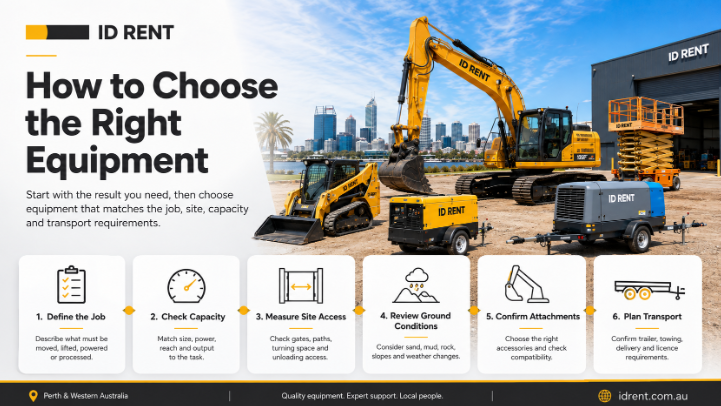
Start with the result you need, not the machine name.
Explain what material must be moved, cut, lifted, compacted, powered, or processed. Also state the required output and expected working hours.
Check the Required Capacity
Each equipment type has important measurements.
For a generator, consider kVA, voltage, phase, and starting load. For an air compressor, check PSI and CFM.
For an excavator, consider operating weight, digging depth, reach, and bucket size. For a wood chipper, check branch capacity and expected daily volume.
For lifting equipment, confirm the load weight, required height, and forward reach.
A machine that is too small can slow the job and operate under extra strain. A machine that is far larger than needed may increase transport and hire costs.
Measure Site Access
Check gates, paths, overhead restrictions, building entrances, turning areas, slopes, and soft ground. Confirm where the delivery vehicle can unload.
Measure the full route from the unloading point to the work area. A machine may fit inside the site but still be unable to pass through an entrance.
Locate underground services before digging or trenching begins.
Review the Ground Conditions
WA sites may include sand, hard ground, loose soil, mud, rock, and steep areas.
Tracked machines may offer better grip and lower ground pressure in some conditions. Wheeled machines may move faster on firm surfaces.
Ground conditions can also change after heavy rain or repeated vehicle movement. Consider the expected conditions during the full hire period.
Share site photographs and measurements with the rental team when possible.
Confirm Attachments and Accessories
An excavator may need a specific bucket, auger, or hydraulic tool. A skid steer may require forks, a trencher, or a bucket. A generator may need leads or a fuel tank.
Attachments should be selected around the material and required result. A general bucket may not be suitable for every digging or loading task.
Confirm that each attachment is compatible and included in the quote.
Consider Transport
Some equipment can be collected on a suitable trailer. Larger machines may need professional delivery.
Check the machine weight, trailer rating, vehicle towing capacity, load restraint, and driver’s licence requirements.
ID Rent has trailers for selected equipment under the stated capacity, including small skid steers, stump grinders, trenchers, generators, and compressors.
Professional delivery may be the safer choice when the customer does not have a suitable vehicle, trailer, or loading experience.
How Much Does Equipment Hire Cost in Perth?
Hire prices vary because every project has different needs.
The machine type, size, and hire period affect the base rate. Specialised units may cost more than common small machines. Daily, weekly, and monthly hires may also use different pricing structures.
Other costs may include:
- Delivery and collection
- Attachments and accessories
- Fuel and cleaning
- Damage waiver or insurance
- Operating-hour limits
- Consumables
- Remote mobilisation
- Late returns
- Excess wear or damage
Ask for the expected total rather than comparing daily rates alone.
Two quotes may show similar machines but include different services. One may include servicing or delivery, while another charges separately.
A useful quote should identify the machine, attachments, hire dates, transport, included hours, payment terms, and customer responsibilities.
Also confirm how extensions are charged. A project may run longer because of weather, site delays, or changes in scope.
Contact the rental company before the agreed return date when an extension is needed. Keeping the machine without approval may lead to extra charges or affect another customer’s booking.
Licences, Training, and Safety in WA
Operators must be trained and competent for the equipment they use.
Some high-risk work requires a High Risk Work Licence in Western Australia. WorkSafe lists licensed work such as operating forklifts, cranes, hoists, and certain elevating work platforms.
A boom-type elevating work platform with a boom length of 11 metres or more requires the relevant licence. Operators of other EWPs still need suitable training, information, and instruction.
Requirements depend on the machine and the work. Check current WorkSafe WA guidance before starting.
Even when no formal licence is required, the operator must understand the controls, limits, hazards, and emergency procedures.
Site rules may also require inductions, evidence of competency, risk assessments, or Safe Work Method Statements.
Complete a pre-start inspection before use. Check for damage, leaks, worn tyres or tracks, loose attachments, damaged guards, warning lights, and faulty safety devices.
Stop using the machine if a serious fault appears. Report it instead of attempting an unauthorised repair.
Delivery and Regional WA Logistics
Equipment hire in Perth may involve branch collection or delivery to the site.
Before delivery, confirm there is enough room for unloading. Give the driver clear access instructions and the contact details of the person receiving the machine.
Check whether traffic management or site approval is needed during unloading. The work area should be clear before the delivery vehicle arrives.
Regional work needs more planning. Distance can affect transport time, cost, servicing, and breakdown response.
For remote projects, ask about:
- Delivery timing
- Fuel supply
- Service intervals
- Spare parts
- Site access
- Communication coverage
- Breakdown support
- Replacement options
A small equipment issue can create a long delay when a site is far from Perth. Early planning can reduce this risk.
ID Rent operates from Bellevue and supplies equipment across Perth and Western Australia. It focuses on industrial, construction, environmental, event, mining, utility, and oil and gas clients.
Maintenance and Breakdowns
Discuss maintenance before the machine arrives.
Ask who arranges scheduled servicing and how it will be completed. A long-term hire may require service while the machine is still on site.
ID Rent states that scheduled servicing, maintenance, and related parts are included in its quoted rental rates. Some consumables and Ground Engaging Tools remain the hirer’s responsibility.
Daily care may still include fluid checks, cleaning, greasing, refuelling, and inspecting wear items.
If the machine breaks down, stop work safely and contact the provider. Record warning lights, unusual noises, leaks, or reduced performance.
Do not continue operating equipment that may be damaged. A small problem can become a larger repair or safety risk.
Do not arrange an outside repair without permission. Unapproved work may affect safety, warranties, or responsibility for the repair cost.
Ask how breakdown time is treated in the agreement. Confirm whether replacement equipment may be supplied if a quick repair is not possible.
Your Responsibilities as the Hirer
Read the hire agreement before accepting the equipment.
The hirer is commonly expected to:
- Use the equipment only for its intended purpose
- Provide trained and authorised operators
- Complete daily checks
- Keep the machine secure
- Monitor fuel, fluids, and consumables
- Report faults quickly
- Avoid unauthorised changes or repairs
- Make the equipment available for servicing
- Return it on time and in the required condition
Photograph the equipment when it arrives. Record existing damage, fuel level, attachments, and the hour-meter reading.
Repeat this process before return. Clear records can prevent confusion about damage or missing items.
Security also needs attention. Store keys safely and keep the equipment in a secure location when it is not being used.
Common Equipment Hire Mistakes
Choosing only by price is a common mistake. Delivery, attachments, fuel, and damage charges can change the total cost.
Hiring a machine that is too small can also cause delays. The equipment may take longer to complete the task and work under greater strain.
Site access is another common problem. Measure the full route before booking.
Do not overlook attachments. The main machine may arrive on time but still be unable to complete the work without the correct tool.
Operator requirements also matter. The equipment cannot support the project if no trained person is available to use it.
Finally, allow enough time for the work. Weather, site delays, and scope changes can extend the hire. Contact the provider early when dates change.
Equipment Hire Checklist
Before requesting a quote:
- Define the task and expected output.
- Confirm the location and dates.
- Measure access and review the ground.
- Identify the required capacity and attachments.
- Confirm who will operate the machine.
Before accepting the quote:
- Check the full cost.
- Review delivery and collection.
- Confirm included operating hours.
- Understand maintenance and breakdown support.
- Read the damage and return conditions.
When the equipment arrives:
- Inspect its condition.
- Record existing damage.
- Confirm attachments and accessories.
- Review controls and safety information.
- Check fuel and hour-meter readings.
During the hire:
- Complete daily inspections.
- Operate within the machine’s limits.
- Keep the equipment secure.
- Report faults immediately.
- Arrange access for servicing.
Before return:
- Confirm the off-hire date.
- Clean and refuel it if required.
- Return all attachments.
- Record the final condition.
- Keep proof of collection or return.
Choose Equipment Around the Job
Good equipment hire begins with a clear understanding of the work.
The lowest-priced machine is not always the best value. Suitable equipment can improve output, reduce delays, and make the project easier to manage.
Before booking, review capacity, access, ground conditions, attachments, transport, operator skills, and the expected hire period.
Compare the full quote and check what support is available during the hire.
ID Rent provides short-term and long-term equipment hire across Perth and Western Australia. Its range includes general equipment and specialist machines for several commercial industries. The business also supports customers with parts and maintenance services.
For a more accurate recommendation, explain what the equipment needs to do, where it will operate, and how long it will be required.
Frequently Asked Questions
Is Equipment Cheaper to Hire by the Week or Month?
Longer periods may use lower rate structures than repeated daily hire. The final cost depends on the machine, transport, usage hours, availability, and agreed terms.
Does Equipment Hire Include Delivery?
Delivery is not included in every quote. Confirm the location, transport charges, and collection arrangements before accepting the hire.
Who Pays for Fuel?
The hirer commonly pays for fuel used during the hire. Check the agreement and confirm the required return fuel level.
What Happens if Hired Equipment Breaks Down?
Stop using it safely and contact the hire provider. Follow its instructions and do not arrange repairs without approval.
Can Equipment Be Hired for Regional WA Projects?
Many providers support regional projects. Transport, servicing, fuel, and breakdown planning should be discussed early.